Contact Information

2026年5月摩洛哥、阿尔及利亚和也门500m沙漠蝗遥感监测数据集
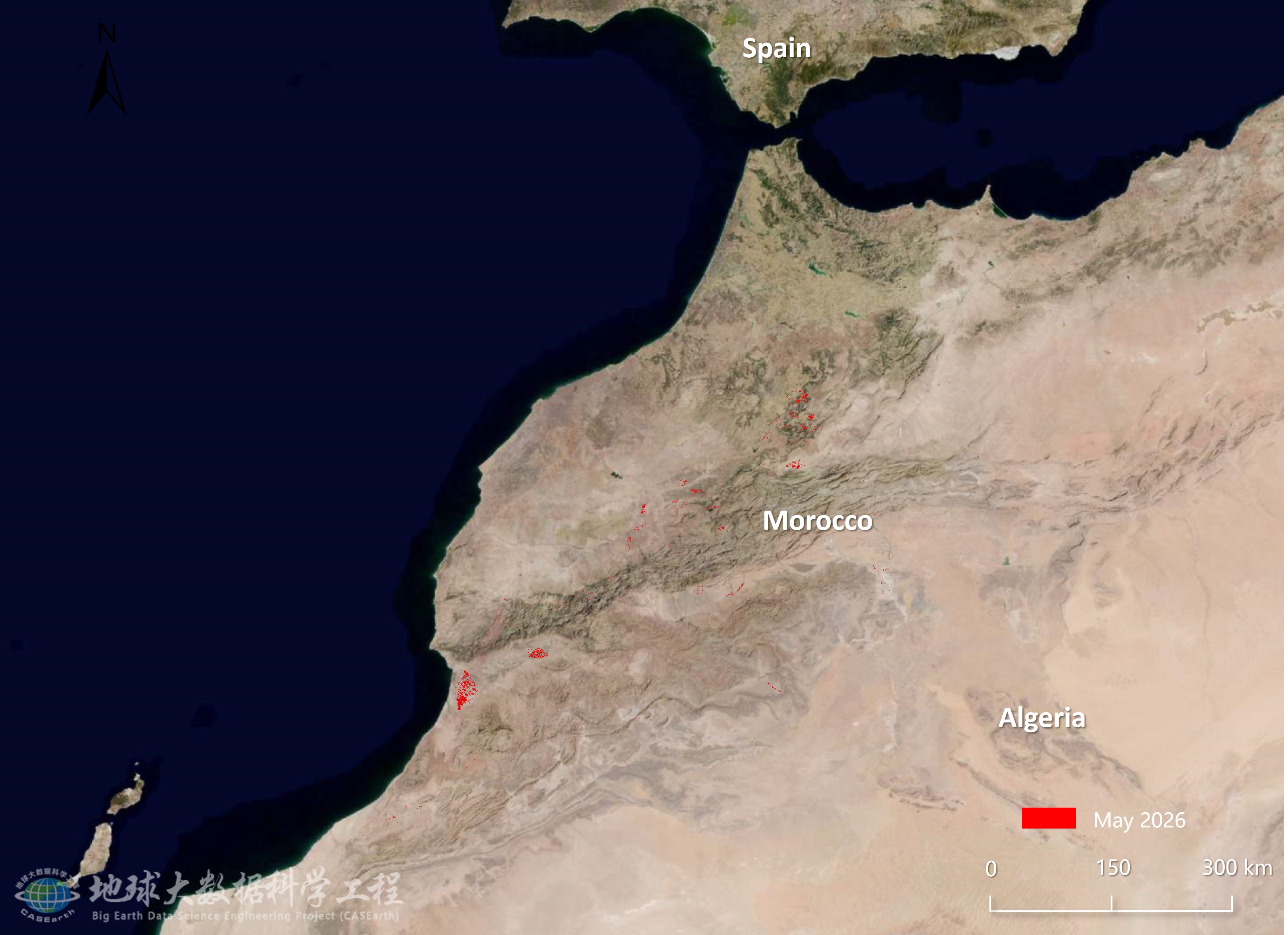
Dataset Overview
in May 2026, desert locusts mainly distributed the central-southwestern regions of Morocco, localized northwestern and central areas of Algeria, and the southern inland areas of Yemen, affecting 88.3, 25.1, and 16.6 thousand hectares of vegetation, respectively. In Morocco, spring breeding entered its late stage. Previous wet conditions promoted sustained vegetation greening in central-southwestern areas, while more immature adult groups formed following hopper groups fledging. The affected area expanded slightly from April and extended eastward and southward along the Draa Valley and southern desert margins. Some locust populations may subsequently move east into suitable areas of western Algeria, while others may move south into Mauritania and Sahel summer breeding areas. In Algeria, localized locust populations were relatively dense in the northwest under the combined influence of influxes from Morocco and suitable vegetation conditions. Sporadic populations increased along the central-southern desert margins, indicating a shift from the northwest toward central-southern suitable patches. In Yemen, small oases and wadi habitats remained in the southern Gulf of Aden coastal plains and inland transition zones; together with the possible southward movement of sporadic adults from late spring breeding areas in inland Saudi Arabia, this maintained low-density localized activity. Over the next two months, remaining hoppers in Morocco will continue fledging, and some adults may disperse into suitable areas of western Algeria under local wind conditions. As the seasonal rain belt in the Sahel moves gradually northward, localized summer breeding habitats may form; however, due to below-average rainfall in the northern Sahel, the development of a continuous suitable green belt remains uncertain. Some mature adults may move south from the southern margins of Morocco into Mauritania and Sahel countries. In central-southern Algeria, scattered rainfall and localized greening patches may still support short-distance dispersal and small-scale breeding. In Yemen and along the Red Sea coastal areas, rainfall and vegetation conditions are generally limited, and locust activity is expected to remain at low-density and sporadic levels. During this period, winter wheat, barley, and other cereals in Morocco and Algeria are mostly at the filling to maturation or pre-harvest stage, while some maize and fodder crops are entering the sowing and seedling emergence stage. In southern Yemen, sorghum, maize, millet, and other summer crops are at the sowing and seedling emergence stage, and pasture is also entering the recovery stage. Continued monitoring is recommended to prevent localized recurrent impacts on agropastoral production.

Dataset Details
Spatial Resolution:
Time Resolution:
Product Number: XDA19080304281
Create Institution: International Research Center of Big Data for Sustainable Development Goals(CBAS);Big Earth Data Center,CAS
Created By: Yingying Dong
Creation Date: 2026-09-20 09:56:34
File Size: 1
Data Format: Geotiff
Type Of Data: 栅格
Data Label:
