Contact Information

Desert Locust Monitoring in Egypt, Saudi Arabia and Yemen in 2026/01(Spatial resolution-500m)
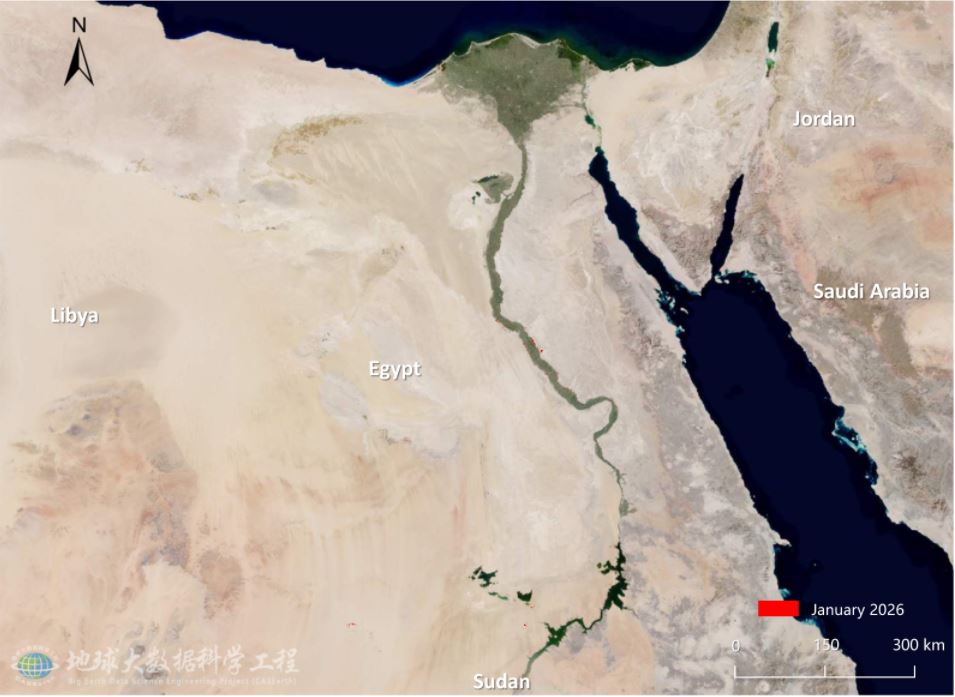
Dataset Overview
Remote sensing monitoring showed that, in January 2026, desert locusts were mainly distributed in the upper Nile Valley corridor of Egypt, the southwestern Red Sea coastal zone of Saudi Arabia, and the southern Gulf of Aden coastal plains of Yemen, affecting 15.7, 19.2 and 21.2 thousand hectares of vegetation, respectively. Over the next two months, desert locust activity across the region is expected to rise moderately as spring rainfall gradually increases. Populations are also expected to become increasingly concentrated along the Red Sea and Gulf of Aden breeding belts. In Egypt, only small numbers of scattered adults are likely to persist in the southeastern Red Sea and southern irrigated areas, and large-scale population buildup is unlikely. In Saudi Arabia, localized small-scale spring breeding may occur along the western Red Sea coast, but overall expansion remains limited. In Yemen, activity is expected to remain confined to low-density adults and hoppers along the Gulf of Aden coastal plains. Given that this period aligns with the main growing season in Egypt and Saudi Arabia and the major harvest season in Yemen, continued monitoring is recommended to prevent recurrent impacts on agropastoral production.

Dataset Details
Spatial Resolution:
Time Resolution:
Product Number: XDA19080304277
Create Institution: International Research Center of Big Data for Sustainable Development Goals(CBAS);Big Earth Data Center,CAS
Created By: Dong Yingying
Creation Date: 2026-03-10 16:41:59
File Size: 1
Data Format: Geotiff
Type Of Data: 栅格
Data Label:
